

Preparing Your Spa Website for Holiday Rush Traffic: How Hostinger Handles Black Friday & Valentine's Day Booking Spikes
Spa website holiday traffic doesn’t behave like your normal Tuesday afternoon browsing. Black Friday gift card sales, Valentine’s Day couples’ spa bookings, Mother’s Day gift purchases — these are the days that can make up a disproportionate share of your annual revenue, all compressed into a handful of high-pressure hours.
If your site slows down or your booking calendar times out on a regular Tuesday, you lose a booking or two. If the same thing happens on Black Friday or the week before Valentine’s Day, you could be losing dozens of gift card sales and appointment bookings in a single afternoon — during the exact days you spent months building marketing momentum toward.
Preparing for this isn’t complicated, but it does need to happen before the traffic arrives, not during it.
Disclosure: This post recommends tools and services based on personal use and experience. If I join an affiliate program for any of these in the future, I’ll clearly mark those links as affiliate links.
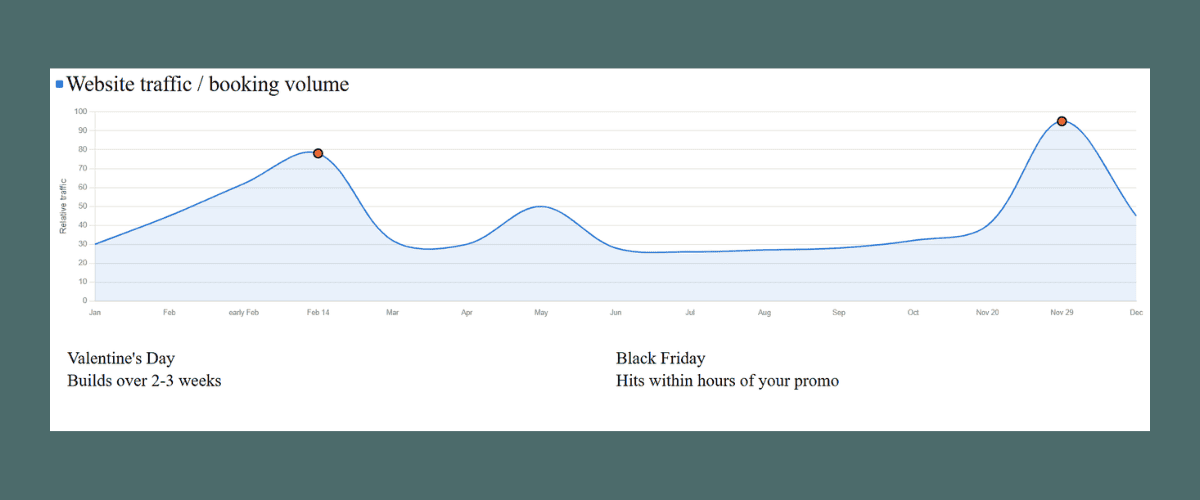
Why Holiday Traffic Spikes Are Different From Normal Daily Traffic
Regular daily traffic on a spa website tends to spread out — a booking here, a browse there, throughout the day. Holiday traffic doesn’t work that way.
A few things make these spikes uniquely demanding on your hosting:
- Volume concentrates into hours, not days. A Black Friday promo email or Instagram post can send a large portion of your entire week’s traffic into a two-to-three-hour window right after it goes out.
- Gift card purchases and bookings happen at the same time. Unlike a normal day where someone might just browse services, holiday traffic often means WooCommerce checkout (gift cards) and Amelia’s real-time availability checks (bookings) both hammering your server simultaneously.
- Mobile traffic surges disproportionately. Social media promos drive people straight from their phone to your site, meaning your mobile booking flow needs to hold up under far more concurrent load than usual.
This concentrated, dual-system pressure is exactly the scenario that exposes any gaps in hosting resources — the kind of gaps that might never show up on a normal day.
What Actually Breaks on Unprepared Hosting During a Spike
If you’ve read about how WooCommerce and Amelia demand real-time database queries for every booking interaction, holiday traffic is that same problem multiplied by a much larger number of simultaneous visitors.
Here’s what tends to go wrong on hosting that isn’t ready for it:
- Gift card checkout slows down or stalls. With multiple people trying to complete WooCommerce transactions at once, limited PHP workers mean some visitors sit on a spinning checkout page.
- The booking calendar times out. Amelia’s real-time availability checks compete for the same limited server resources, and under high concurrency, the calendar can fail to load available slots entirely.
- The site slows or crashes at the worst possible moment. The exact hours your promotion is working — right after that email or Instagram post goes out — are the hours your site is under the most pressure.
The frustrating part is the same as any performance issue: most visitors who hit a slow or broken checkout simply leave. They don’t email you to complain. They just don’t complete the purchase, and you never see the lost revenue as a specific number — only as a promo that “didn’t perform as well as expected.”
How Hostinger's Infrastructure Handles Traffic Spikes
Hostinger’s LiteSpeed-powered infrastructure is genuinely well-suited to handling traffic spikes, but the plan tier and configuration still matter.
LiteSpeed’s efficiency under load comes from how it processes requests at the web server level rather than relying entirely on WordPress to handle everything — this becomes especially valuable during concentrated traffic, since it reduces the load hitting your database for anything that can be served from cache.
Caching strategy matters more during spikes, not less. Static pages — your homepage, service pages, gift card landing pages — should be fully cached via LiteSpeed Cache so server resources are freed up specifically for the dynamic parts that can’t be cached, like the booking calendar and checkout process.
Plan tier realistically affects how much concurrency you can handle. An entry-level shared hosting plan with limited PHP workers, adequate for everyday traffic, is far more likely to strain during a genuine spike than a mid-tier plan built for higher concurrent load. If your everyday traffic is already close to your plan’s limits, holiday traffic is where that gap becomes visible.
None of this means you need the most expensive plan available — it means matching your plan and configuration to your actual expected peak, not just your average day.
Pre-Holiday Website Checklist
Run through this before any major promotional date:
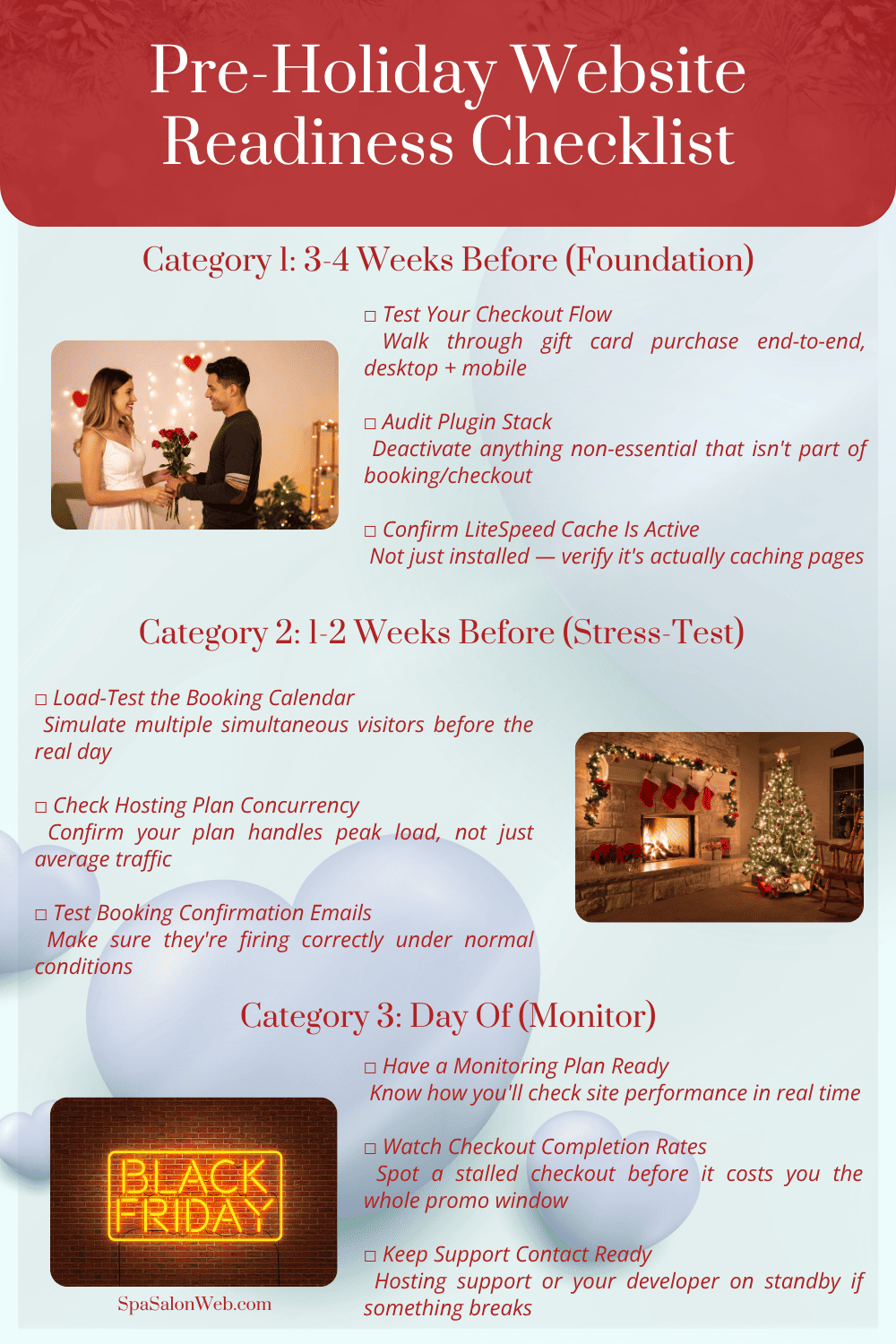
- Test your gift card checkout flow end-to-end, on both desktop and mobile, well before the promotion launches.
- Audit your plugin stack for bloat. Deactivate anything non-essential temporarily during your highest-traffic window if it’s not contributing to the booking or checkout flow.
- Confirm LiteSpeed Cache is active and properly configured — not just installed, but actually caching your static pages.
- Load-test before the actual day. Simulate multiple simultaneous visitors going through the booking and checkout flow to catch bottlenecks while you still have time to fix them.
- Have a monitoring plan for the day itself. Know how you’ll check if the site is performing well in real time, rather than finding out after the promotion ends.
When to Start Preparing: Realistic Timelines
For Black Friday: Start your technical readiness check 3-4 weeks out. This gives enough time to catch and fix issues, upgrade hosting if needed, and still do a final test run the week before.
For Valentine’s Day: Couples’ spa bookings tend to build up over 2-3 weeks beforehand rather than spiking on a single day, so start your readiness check about a month out, with extra attention to your booking calendar’s concurrent availability handling during that build-up period.
For any recurring seasonal spike (Mother’s Day, holiday gift season): use your own historical traffic data from the previous year as your guide — if you don’t have that data yet, this year’s spike is the moment to start tracking it for next year.
Getting Ready Without the Guesswork
You don’t need to overhaul your entire website every holiday season. You need to know, ahead of time, whether your current hosting and configuration can actually handle the volume you’re expecting — and fix any gaps while you still have weeks to do it, not hours.
Want a straight answer before your next big promotional date? I offer a pre-holiday website readiness check for spa and salon businesses — I’ll review your hosting tier, caching setup, and booking/checkout flow, and tell you honestly whether you’re ready for Black Friday or Valentine’s Day traffic, or what needs fixing first.

Get a Free Pre-Holiday Website Readiness Check
Frequently Asked Questions — spa website holiday traffic
Q1: Why does spa website holiday traffic cause more problems than everyday traffic?
A: Holiday traffic concentrates into short, high-volume windows and often combines WooCommerce checkout (gift cards) with real-time booking calendar checks happening simultaneously, putting far more pressure on server resources than typical daily browsing.
Q2: How early should I prepare my spa website for Black Friday or Valentine's Day?
A: For Black Friday, start technical readiness checks 3-4 weeks in advance. For Valentine’s Day, start about a month out since couples’ bookings tend to build up over several weeks rather than spiking on one day.
Q3: Does Hostinger's hosting handle high-traffic booking spikes well?
A: Hostinger’s LiteSpeed-powered infrastructure is efficient under load when properly configured with active caching, but the plan tier matters — a plan adequate for everyday traffic may still strain during a genuine holiday-level spike if concurrency limits are close to your everyday usage already.